

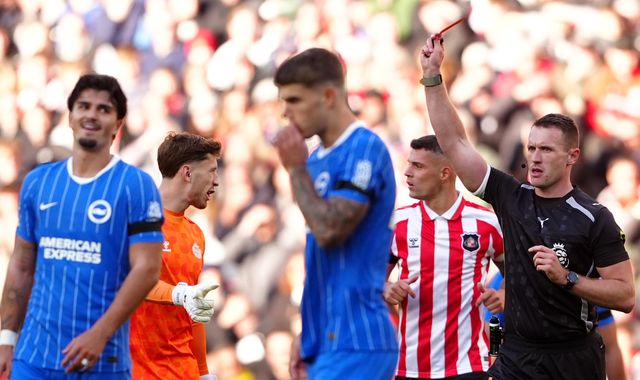
Struijk was dismissed for denying an obvious goal-scoring opportunity in the second half of Brighton’s 2-0 win over Sunderland earlier this month when he was adjudged to have fouled Sunderland striker Wilson Isidor as he tried to latch onto a pass that ran through to goalkeeper Bart Verbruggen.
Neither referee Thomas Bramall nor his assistant gave a foul but VAR Neil Davies intervened and recommended an on-field review. Bramall watched several replays before changing his decision and showing Struijk a red card.
- Premier League fixtures & scores | FREE PL highlights▶️
- Got Sky? Watch Premier League games LIVE on your phone📱
- Not got Sky? Latest Sky Sports deals or stream PL games with no contract📺
However, Brighton appealed on grounds of wrongful dismissal and an independent regulatory commission, which is convened through the FA to consider disciplinary matters, overturned the red card and subsequent one-match ban.
But disagreements over the decision have continued after the Key Match Incidents (KMI) panel voted 3-2 that the VAR intervention was correct.
The KMI panel ruled that Struijk committed a “cynical foul clearly impacting the attacker’s ability to gain possession of the ball which should have been penalised by the referee”.
But two KMI panellists believed the VAR intervention was incorrect because it was subjective whether Isidor would have gained possession.
The Premier League said the KMI panel and an independent regulatory commission can reach different conclusions because they are “entirely separate bodies with different purposes and processes”.
Red cards for denying an obvious goal-scoring opportunity are rare after a VAR review because they are so subjective.
It happened only three times last season when Liverpool’s Dominik Szoboszlai and Crystal Palace’s Maxence Lacroix saw red, but Marcos Senesi escaped after referee Jarred Gillett rejected VAR advice that the then-Bournemouth defender should have been sent off.
VAR is also operating with a “lighter-touch” approach this season to avoid re-refereeing on-field decisions, so former Premier League referee Mike Dean said it was not a clear mistake that needed rectifying.
“I don’t think it’s a sending off, it’s very harsh,” he said. “There’s a slight barge but the ball has gone through to the goalkeeper. Isidor is never going to get the ball so the on-field decision is correct.
“It’s not clear and obviously wrong so why should the VAR get involved? It’s a free-kick but not a red card. It’s the wrong call.”
Dermot Gallagher, another ex-Premier League referee, felt the incident could be deemed a “possible” goal-scoring opportunity.
“It’s a foul. If the referee whistles at that point, pulls out a yellow card, it all goes away,” he said.
“VAR got involved because they felt the player would gain control of the ball. With the goalkeeper there, I wonder if it goes from obvious to a possible goalscoring opportunity. If it does, it’s a yellow.”
Sky Sports’ Michael Dawson and Jay Bothroyd both felt it was a subjective decision so VAR should not have got involved.
Dawson said: “I wasn’t sure whether Isidor was going to get the ball.
“I’d have stayed with the on-field decision. It’s not clear and obvious, it’s subjective. If a red card was given on-field then no problem.”
Bothroyd added: “I think the ‘keeper is getting there. At the bare minimum, the goalkeeper is competing. It is not obvious that Isidor is going to get there. I don’t think it should be a red card.”